
Color development principle of colloidal gold test strip

2024-06-05

分享
The color development principle of colloidal gold test strips is essentially a visual representation of a well-designed "antigen-antibody specific reaction". Here is a detailed explanation of each step and the key concepts behind it. Colloidal Gold and Immunochromatography
Colloidal gold itself is a stable colloid formed by the polymerization of gold atoms under the action of a reducing agent (e.g., chloroauric acid). It serves as the perfect chromogenic marker because, in a weak alkaline environment, the negative charges on its surface can firmly bind with positive charge groups on protein molecules (such as antibodies) via electrostatic adsorption. This binding process does not affect the biological activity of the protein. In immunochromatography, this antibody-labeled colloidal gold acts as a tracer. As the liquid sample moves forward via capillary action on the nitrocellulose membrane of the test strip, it reacts with the fixed antibodies, enabling the detection of the target substance .
 T-Line Color Development
The color development of the T-Line (Test line) is direct evidence for the presence of the target substance (e.g., an antigen) in the sample.
Key Structure: The T-line is coated with an antibody that recognizes the target antigen (this antibody binds to a different epitope on the same antigen recognized by the antibody conjugated to the colloidal gold).
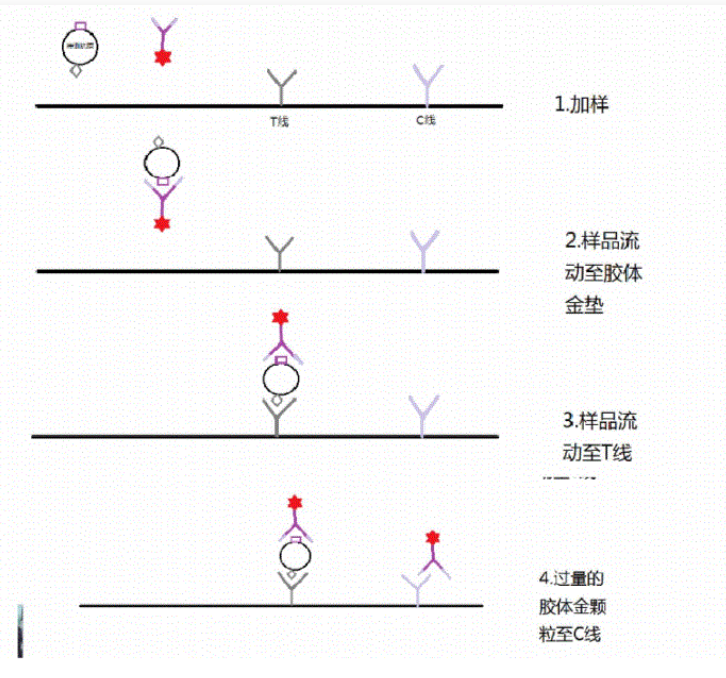
Color Development Process: When the sample contains the target antigen, the antigen first binds to the colloidal gold-conjugated antibody on the conjugate pad, forming a complex. This complex continues to flow with the liquid to the T-line, where it is captured by the antibody fixed on the T-line, forming a "T-line antibody - target antigen - colloidal gold-conjugated antibody" ternary complex.
Result Interpretation: The accumulation of a large number of colloidal gold particles at the T-line causes it to appear as a red band, indicating a positive result. If the sample does not contain the target antigen, this complex cannot form, the T-line does not develop color, and the result is interpreted as negative .
C-Line Color Development
The color development of the C-Line (Control line) is an internal control indicating whether the test procedure was performed correctly and the reagents are functioning.
Key Structure: The C-line is coated with an antibody that specifically recognizes the colloidal gold-conjugated antibody (often a species-specific anti-immunoglobulin).
Color Development Process: Regardless of whether the target antigen is present in the sample, excess colloidal gold-conjugated antibodies continue to move forward with the fluid. When they reach the C-line, these gold-conjugated antibodies are captured and bind to the antibody on the C-line.
Result Interpretation: The accumulation of colloidal gold particles causes the C-line to turn red. The C-line must develop color in any valid test where the procedure was followed correctly and the reagents are functional. If the C-line does not develop color, it indicates an invalid test, and the test should be repeated .
 Core Advantages and Value
The colloidal gold immunochromatography method transforms invisible immune reactions into intuitive color signals. Its value lies in its simple operation, rapid results (typically within 15 minutes), low cost, and no requirement for complex equipment, making it highly suitable for primary screening and point-of-care testing .


 WeChat subscription account